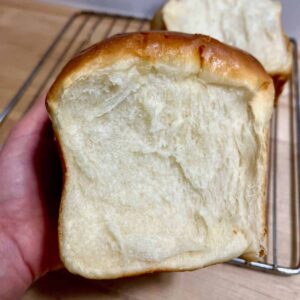
Shokupan Japanese Milk Bread
Because most household loaf pans are 8.5 x 4.5 x 2.5 (classified as "1 lb loaf pan"), I have designed this recipe so you can make shokupan at home without having to buy additional pans. If you would like to make a perfectly square loaf, the post includes information on what pan to purchase, as well as the dough quantity needed.This shokupan is a two-day process. Please note that there are instructions for "Day 1" and "Day 2".The equipment section only lists specific "specialty" items needed for this recipe. Additional bowls, spoons, cups, spatulas may be required.
Equipment
- Kitchen Scale
- KitchenAid Mixer + Hook Attachment
- Bench Scraper/Knife To cut dough (regular knife works)
- Rolling Pin
- Bread Pan size for this recipe: 8.5 x 4.5 x 2.75 (inches)
Ingredients
Yudane (Mix on Day 1)
- 65 g Bread Flour recommend: Bob's Red Mill Artisan Bread Flour
- 65 g Water Boiling
Dry Ingredients
- 260 g Bread Flour recommend: Bob's Red Mill Artisan Bread Flour
- 4 g Instant Yeast for active dry or fresh yeast, see note (1) below
- 36 g Granulated Sugar
- 5 g Salt
Liquid Ingredients
- 195 g Whole Milk
Fat
- 20 g Unsalted Butter soft
Instructions
Day 1. Make Yudane
- Measure flour for yudane (65g) in a small bowl
- Bring water to boil in a small pot or kettle. Add 65g boiling water to flour. Stir together with a spoon. Once it's cool enough to handle, knead dough for thirty seconds. Store in a small container, cover with plastic wrap and place in fridge.
Day 2. Make Shokupan
Combine dry ingredients
- In bowl, combine flour (260g), yeast, sugar and salt
Mix dough
- Heat milk to room temp using stovetop or microwave. Bring the milk to a temperature that feels neither hot or cold (somewhere near 80℉). Add milk and yudane to KitchenAid bowl. Place dry ingredients on top of milk and butter on top of dry ingredients.
- Mix on low speed until there are no visible traces of butter or flour. Increase speed to medium/medium-high.
- After a few minutes, stop mixer and scrape down sides of bowl. Continue to mix on medium/medium-high until the dough is no longer sticking to the sides and bottom of bowl. The dough should be smooth and pass the windowpane test (image #2 under "Pay Careful Attention" section).
Bulk Ferment (1st rise)
- Round dough to create a smooth top and place into a lightly oiled bowl. Cover and allow dough to rise to 2.5 - 3x it's original size. This could take 1 to 3 hours depending on the final temperature of the dough and temperature of the room. An hour-and-half is about average for a moderately warm room. Use visual cues and the poke test to determine if the dough is sufficiently proofed(2).
Divide & Preshape
- Dust flour onto a clean surface and invert bowl, allowing dough to fall onto dusted area. Square off the dough then cut in half, each piece should weigh around 320g. Pre-shape each piece into a loose ball, cover and rest 15-20 minutes
Shape (please see "Technique" section for visuals)
- Flour counter and, working with one dough at a time, flatten each piece into a rectangle.Using a rolling pin, roll the dough out until the length is roughly 2x the widthFold so the sides meet in the middleStarting at one end, roll the dough to the other endPinch the seam to sealPlace rolls in oiled pan, seam side down
Final Fermentation (2nd rise)
- Cover and allow dough to rise to about 2x it's original size. This could take 1 to 3 hours depending on the temperature of the dough and room. An hour-and-half is about average for a moderately warm room. Use visual cues and the poke test to determine if the dough is sufficiently proofed (2). If using a 1 lb loaf pan, the dough should dome up as pictured in image #4 under the "Pay Careful Attention" section.
Bake
- About 15 - 20 minutes before your your loaf is ready to go into the oven, turn on oven and heat to 350℉ (oven rack placed second spot from bottom). When the loaf and oven are both ready, place pan directly on oven rack and bake for 25-35 minutes (my loaf took 32 minutes). Careful not to remove from the oven too early or the bread will sink in on itself (internal temperature should read 195-200℉).
Cooling, Eating and Storing
- Remove shokupan from pan and allow to cool on wire rack.Shokupan is really good when still warm from the oven, especially with a little butter and jam. For sandwiches and toast, it's best to slice on the second day (it's very difficult to cut on day one because it's so soft).I like to slice shokupan the day after baking, place in a plastic bag and freeze for future toasts and sandwiches.
Notes
- When using commercial yeast, I always recommend using instant dry. That said, most people still use active dry yeast and there's no point in buying more yeast if that's what you have in your kitchen. If using active dry yeast, change the quantity to 5 grams. Active dry yeast needs to be "activated" - to do so, take about ¼ cup of milk from the recipe and warm it to about 105 degrees Fahrenheit. Sprinkle yeast on top, give a quick stir and leave it for about 15 minutes. Add to milk/yudane. If using fresh yeast, change the quantity to 12g. Crumble and add to milk. Proceed with recipe as instructed.
- How to tell when fermentation is complete. A well-proofed dough will look and feel a little like a balloon and still have a nice sheen to it. To do the poke test, dip your finger in flour and push it into the dough about ½" (halfway up your first knuckle). Under-proofed dough will resist and the dough will spring back. Properly proofed dough will hold an indentation but will still be springy. Over-proofed dough will look dull, will not spring back when poked and may even deflate. Please Note: There aren't only these three possibilities, where the dough is either under-proofed, perfectly proofed or over-proofed. Your dough can be somewhat under or over proofed, and still result in a nice loaf. The key is to stay in the range of acceptable parameters (don't under or over proof to the extreme) and, over time, learn to determine how far you can push the boundaries.
Nutrition
Calories: 1550kcalCarbohydrates: 313gProtein: 17gFat: 24gSaturated Fat: 14gPolyunsaturated Fat: 1gMonounsaturated Fat: 6gTrans Fat: 1gCholesterol: 66mgSodium: 2163mgPotassium: 402mgFiber: 8gSugar: 57gVitamin A: 816IUVitamin C: 16mgCalcium: 737mgIron: 18mg
Tried this recipe?Let us know how it was!