




Many new cottage bakers search for a cookie pricing calculator or ask a simple question:
How much should homemade cookies cost?
If you’re unsure what to charge, there’s a good chance you’re underpricing.
Most home bakers:
• don’t include labor
• underestimate overhead
• base prices on what others charge
👉 which often leads to prices that don’t support the business long-term
If your prices feel right but your business still isn’t making money, there’s often more going on than pricing alone.
👉 Why Your Baking Business Isn’t Making Money (Even If You’re Selling)
Multiple times a week, I see someone ask:
“How much should I charge for homemade cookies?”
The answers are all over the place.
$20 per dozen.
$3 each.
“Don’t undersell.”
But pricing baked goods isn’t something you can solve from a photo in the comments.
Ingredient cost, cookie size, labor time, packaging, and even your local market all influence the math. That’s why crowd-sourced pricing advice is often misleading.
In professional kitchens, pricing starts with something much simpler: understanding the real cost of the product.
If you want a number you can stand behind, the process begins with two things:
• Your true cost
• A clear understanding of profit
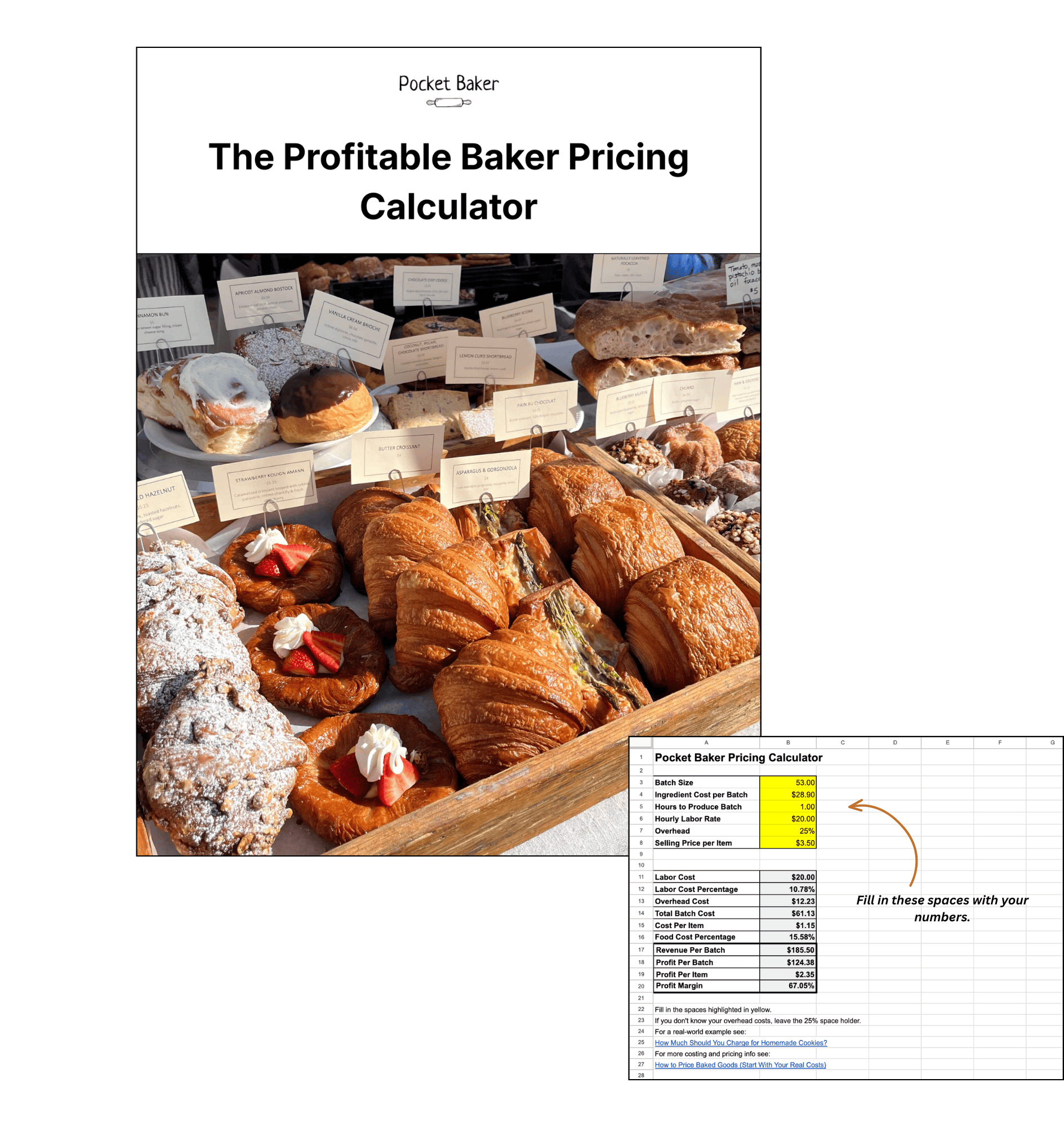
In this guide, we’ll walk through the same framework professional kitchens use to price baked goods. Later in the article, you’ll also be able to estimate your own pricing using the Pocket Baker cookie pricing calculator.
Let’s start with the basic formula.
Quick Answer: How Much Should Homemade Cookies Cost?
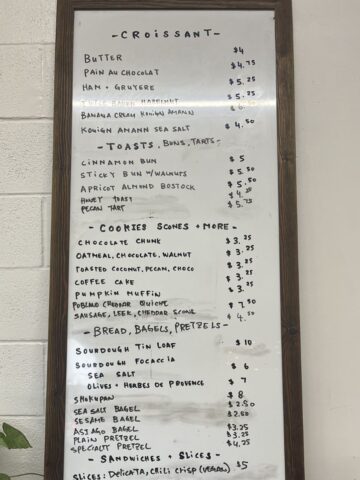
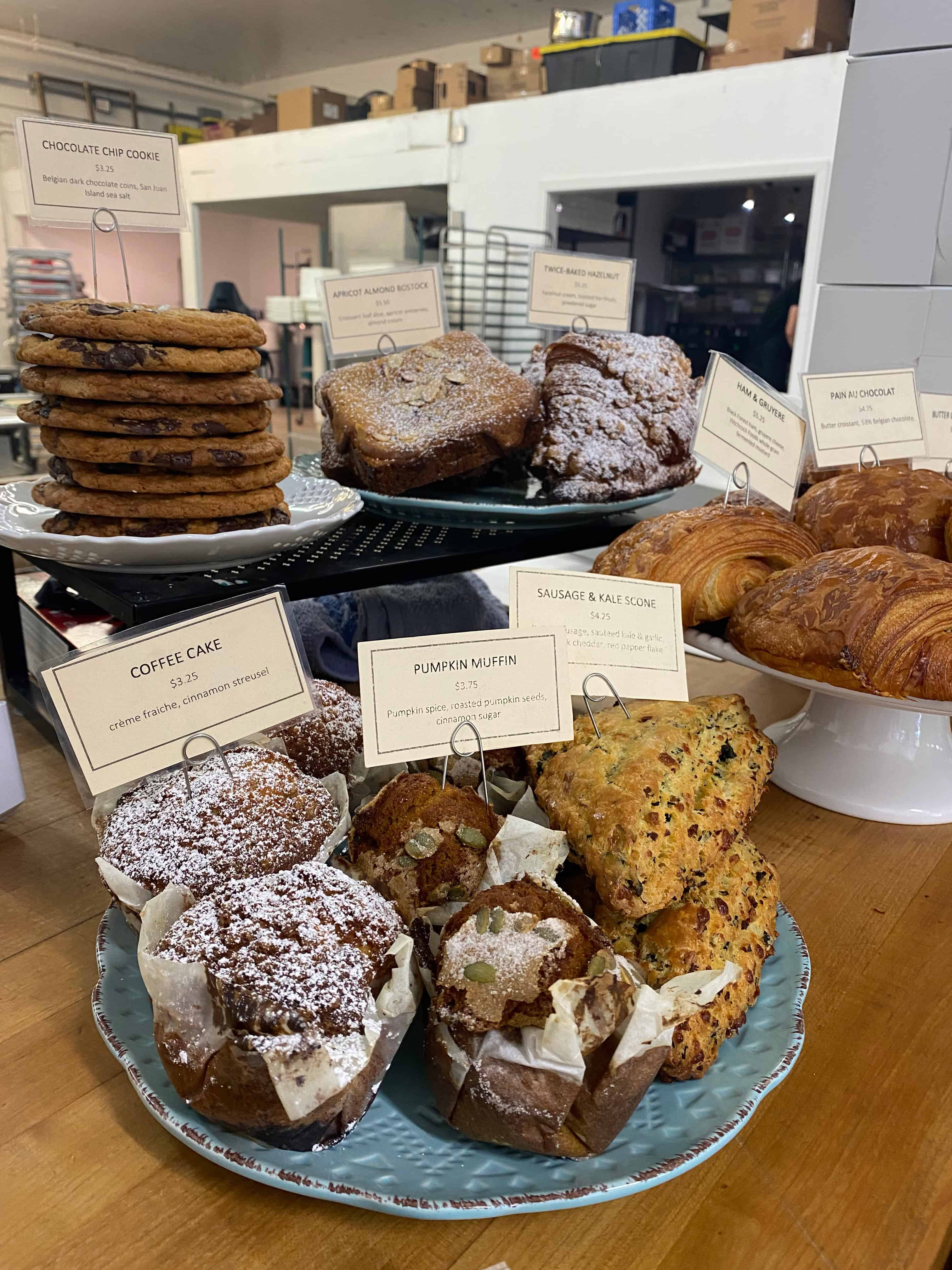
In many U.S. markets, premium homemade cookies typically sell for $3 - $4 each, depending on size, ingredients, and location.
But the correct price always starts with calculating your true cost - including ingredients, labor, and overhead - and then choosing a selling price that leaves room for profit and reflects the value of your product.
The step-by-step method below shows exactly how to calculate it.
Jump to:
- Quick Answer: How Much Should Homemade Cookies Cost?
- The Basic Bakery Pricing Formula (How Bakeries Price Baked Goods)
- Step 1: Calculate Your True Cost (Cost of Homemade Cookies)
- Get the FREE Profitable Baker Pricing Calculator
- Step 2: Choose a Selling Price
- Step 3: Calculate Your Profit Margin
- Final Cost & Selling Price
- Common Cookie Pricing Questions
- Pricing System (Start Here)
- Final thoughts
- Pocket Baker Perspective
The Basic Bakery Pricing Formula (How Bakeries Price Baked Goods)
Most baked goods are priced using a straightforward framework:
Ingredients + Labor + Overhead = Total Cost
Once you understand your total cost, you can choose a selling price that leaves room for profit.
When all costs are accounted for - including ingredients, labor, and overhead - many small bakeries ultimately see net profits around 5 - 15%, with about 10% considered a healthy and sustainable outcome.
That may sound smaller than expected, but food businesses often operate on thin margins. Pricing has to support far more than ingredients alone, including labor, equipment, utilities, packaging, insurance, and the inevitable waste that comes with perishable products.
Cottage bakers may sometimes achieve slightly higher profits because they often operate with lower fixed costs, such as retail rent or large payrolls. Still, the same principle applies: prices must support the full cost of running the business if the operation is meant to remain sustainable over time.
This basic formula works for cookies, cakes, breads, and pastries, and it gives you a much more reliable starting point than guessing based on what someone else charges.
Let’s walk through it step by step.
Step 1: Calculate Your True Cost (Cost of Homemade Cookies)
For a deeper walkthrough of recipe costing, see:
👉 How to Price Baked Goods (Start With Your Real Costs)
We’ll use a chocolate chip cookie batch as an example.
Ingredient Cost (Per Batch)
Total ingredient cost: $28.90
Batch size: 53 cookies
$28.90 ÷ 53 = $0.55 per cookie
👉 What Is Food Cost in Baking?
Add Labor
If the batch takes 1 hour total (mixing, scooping, baking, cleaning):
$20 ÷ 53 = $0.38 per cookie
Running total:
$0.55 + $0.38 = $0.93 per cookie
👉 How to Calculate Labor Cost in Baking
Add Overhead (25% Placeholder)
Overhead includes:
• utilities
• packaging
• cleaning supplies
• equipment wear
• insurance
• market fees
If your business is new and you don’t have exact records yet, you can use a placeholder percentage.
Ingredients + Labor:
$28.90 + $20.00 = $48.90
25% of $48.90 = $12.23 per batch
$12.23 ÷ 53 = $0.23 per cookie
👉 What Is Overhead in a Baking Business?
Your True Cost
Per batch:
$28.90 + $20.00 + $12.23 = $61.13
Per cookie:
$1.16
That is your floor.
If you sell below $1.16, you are paying customers to eat your cookies.
Step 2: Choose a Selling Price
Once you understand your cost, the next step is to choose a selling price.
You’re not building your price from cost alone - you’re choosing a price and then evaluating whether it works.
Let’s say you choose $3.50 per cookie.
53 cookies × $3.50 = $185.50 revenue
Step 3: Calculate Your Profit Margin
Now subtract your true cost.
$185.50 - $61.13 = $124.37 profit per batch
Per cookie:
$3.50 - $1.16 = $2.34 profit per cookie
Now calculate margin:
Profit ÷ Selling Price
$2.34 ÷ $3.50 = 67% profit margin
What This Means
Your cost is 33% of the selling price.
Your profit margin is 67%.
That is strong.
It is also very normal for premium cottage bakery products.
👉 What Is a Good Profit Margin for Baked Goods? (A Clear Guide for Bakers)
Pocket Baker Insight - This does not mean the baker keeps 67% as personal income. Profit must still cover taxes, business growth, equipment replacement, and slower periods when sales fluctuate.
It also supports something bakeries rely on called product mix - how different items across your menu work together to balance demand, profit, and workflow.
👉 What Is Product Mix in Baking?
Some items sell in higher volume but carry lower margins, while others generate stronger margins but sell less frequently. Together, those products balance each other and help stabilize the overall business.
Final Cost & Selling Price
| Cost Type | Per Batch | Per Cookie |
|---|---|---|
| Ingredients | $28.90 | $0.55 |
| Labor | $20.00 | $0.38 |
| Overhead (25%) | $12.23 | $0.23 |
| Total Cost | $61.13 | $1.16 |
Your selling price: $3.50
➡️ Profit per cookie: $2.00+
➡️ Profit per batch: $100.00+
➡️ Profit margin: ~67%
So What Should You Actually Charge?
In many U.S. markets, premium homemade cookies sell for:
$3.00 - $4.00 each
If your cost is $1.16 and you sell at $3.50:
You are profitable.
And you are pricing responsibly.
Common Cookie Pricing Questions
How much should I charge for homemade cookies?
For many cottage bakers in the United States, premium homemade cookies sell for $3 - $4 each, depending on size, ingredients, and local market conditions.
However, the correct price always starts with your actual cost - including ingredients, labor, and overhead.
Once you understand your cost, you can choose a selling price that supports both profitability and sustainability.
What is a good profit margin for baked goods?
When all costs are accounted for - including ingredients, labor, and overhead - many small bakeries ultimately see net profits around 5-15%, with about 10% considered a healthy and sustainable outcome.
That may sound smaller than expected, but food businesses operate on thin margins. Pricing has to support far more than ingredients alone, including labor, equipment, utilities, packaging, insurance, and the inevitable waste that comes with perishable products.
Cottage bakers may sometimes achieve slightly higher profits because they often operate with lower fixed costs, such as retail rent or large payrolls. Even so, successful baking businesses still price their products carefully to ensure the operation remains sustainable over time.
Should homemade cookies be priced per dozen or per cookie?
Most bakers price cookies per cookie, then offer a per-dozen price for larger orders.
Pricing per cookie helps customers clearly understand the value of the product and allows bakers to maintain consistent margins regardless of order size.
Why do homemade cookies sometimes cost more than store-bought cookies?
Homemade cookies are typically:
- made in smaller batches
- more time consuming to produce
- produced with higher-quality ingredients
- mixed, portioned, and baked by hand
- packaged individually
All of these factors increase both cost and value compared to mass-produced cookies.
Pricing System (Start Here)
If you’re unsure where to begin, start with the core pricing guide below.
Step 1: Understand Your Costs
Know exactly what it costs to produce your products.
- 👉 What Is Food Cost in Baking?
- 👉 How to Calculate Labor Cost in Baking
- 👉 What Is Overhead in a Baking Business?
Step 2: Build Your Pricing
Turn your costs into a price that actually works.
- 👉 Core Guide: How to Price Baked Goods (Start With Your Real Costs)
- 👉 Cost vs Value Pricing for Baked Goods
- 👉 Build a Menu That Works (Product Mix)
Step 3: Apply It to Your Products
Use your numbers to price specific items.
- 👉 How Much Should You Charge for Homemade Cookies?
- 👉 How Much Should You Charge for Homemade Cupcakes?
- 👉 How to Price Cakes for Profit
Step 4: Improve Profit Over Time
Refine your pricing as your business grows.
Final thoughts
Cost tells you your minimum.
Understanding how to calculate your cost - and how profit fits into the equation - is the first step toward building a product mix that can actually support a baking business.
This is when baking begins to shift from hobby to business.
Pocket Baker Perspective
In professional kitchens, pricing is never based on guesswork or what someone else charges. Bakers start by understanding their costs - ingredients, labor, and overhead - and then choose prices that support the long-term health of the business.
Pricing is about knowing your numbers, reducing the guesswork, and turning pricing into a strategic decision that allows your baking to remain both enjoyable and sustainable.