




Introduction
One of the most common questions home and cottage bakers ask is:
“How much should I charge for my baked goods?”
Pricing can feel overwhelming at first.
There are a lot of moving parts, and it’s not always clear where to begin.
But when you break it down into smaller steps, it becomes much more manageable.
The starting point is always cost.
To understand your cost, you need to account for:
👉 These work together to give you your true cost.
Pricing requires a deeper view.
This is where you consider:
- profit margins (whether your pricing supports the business)
- value (what customers are willing to pay)
- menu design (how your products work together)
Because pricing isn’t just a calculation.
👉 It’s a system.
If you want to see how this works in a real example, this cookie pricing guide walks through the full process step by step:
👉 How Much Should You Charge for Homemade Cookies? (Stop Guessing - Use This Method)
This post will walk you through the system behind that example - so you can apply it to your own products.
Jump to:
- Introduction
- Quick Answer: How Do You Price Baked Goods?
- How Pricing Actually Works (Big Picture)
- Step 1: Calculate Your True Cost
- Understanding Food Cost (Start Here)
- Step 2: Add Labor and Overhead
- Step 3: Choose a Selling Price
- Important: Cost Is Not Your Price
- Why Pricing Works at the Menu Level
- How These Pieces Work Together
- Next Step: See a Real Pricing Example
- FAQ: Pricing Baked Goods
- Pricing System (Start Here)
- Final Thoughts
- Pocket Baker Perspective
- Get the FREE Profitable Baker Pricing Calculator
Quick Answer: How Do You Price Baked Goods?
To price baked goods, you need to:
- calculate your total cost (food cost + labor + overhead)
- determine your cost per item
- choose a selling price that supports profit and reflects value
Total cost ÷ number of items = cost per item
👉 This gives you your baseline - not your final price.
After you know your cost per item, you choose a price that supports profit and reflects the value of your product.
👉 For a full example using this exact method, see:
How Much Should You Charge for Homemade Cookies? (Stop Guessing - Use This Method)
How Pricing Actually Works (Big Picture)
In practice, pricing happens in stages:
- Calculate your true cost
- Choose a selling price
- Evaluate profit and margin
- Adjust based on menu and demand
Most pricing problems happen when one of these steps is missing.
👉 This post focuses on Step 1 - because everything else depends on it.
Step 1: Calculate Your True Cost
Your cost is made up of three parts:
- food cost (ingredients + direct per-item costs like packaging)
- labor
- overhead
If you miss one of these, your numbers are incomplete.
Most home bakers:
- only calculate ingredients
- underestimate labor
- ignore overhead
👉 which leads to prices that feel profitable - but aren’t
👉 Why Your Baking Business Isn’t Making Money (Even If You’re Selling)
If you want to see how this looks with real numbers, this cookie pricing example walks through each step:
👉 How Much Should You Charge for Homemade Cookies? (Full Breakdown)
Understanding Food Cost (Start Here)
Food cost is the foundation of your pricing.
It includes:
- ingredients
- direct per-item costs (like packaging)
👉 What Is Food Cost in Baking? (And What Is a Good Food Cost Percentage?)
Simple Example
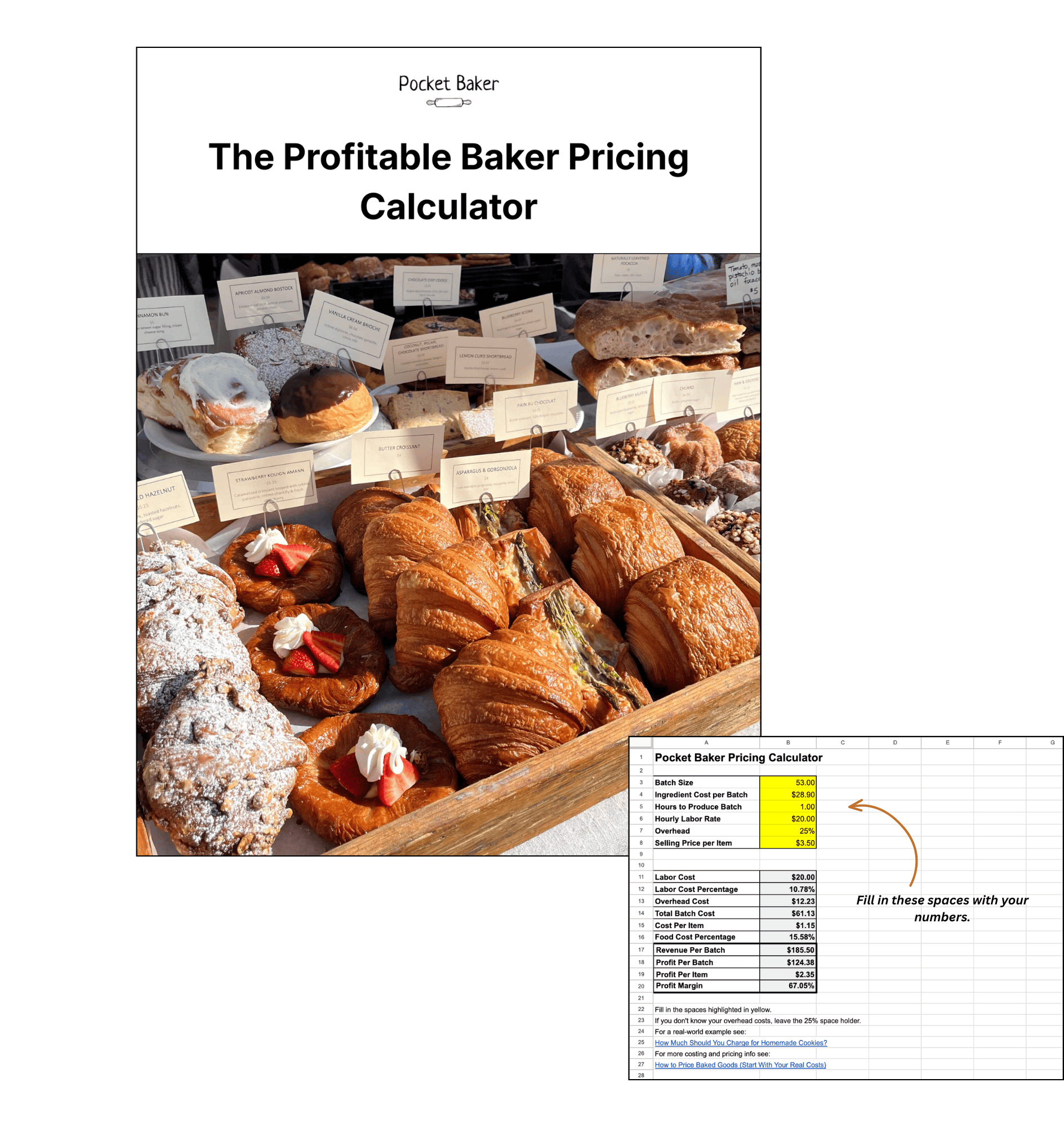
- total food cost per batch: $28.90
- batch size: 53 cookies
➡️ cost per cookie: $0.55
Step 2: Add Labor and Overhead
Labor
Your time has value - even in a home kitchen.
Example:
- 1 hour of work at $20/hour
➡️ $20 per batch
➡️ $0.38 per cookie
👉 How to Calculate Labor Cost in Baking
Overhead
Overhead includes:
- utilities
- equipment wear
- cleaning supplies
- admin time
If you don’t have exact numbers yet, use a placeholder.
Example:
- 25% of (food cost + labor)
➡️ $28.90 + $20 = $48.90
➡️ 25% = $12.23
➡️ $0.23 per cookie
👉 What Is Overhead in a Baking Business?
Step 3: Choose a Selling Price
Once you understand your cost, the next step is to choose a selling price.
Instead of building your price strictly from cost, you start with a price that reflects:
- your product
- your market
- your positioning
Then you evaluate whether that price works.
Example
Let’s say you choose:
➡️ $3.50 per cookie
53 cookies × $3.50 = $185.50 total revenue
Now compare that to your total cost:
➡️ $185.50 (revenue)
➡️ $61.13 (total cost)
➡️ Profit per batch: $124.37
➡️ Profit per cookie: $2.34
What This Tells You
- your cost is supported
- your pricing leaves room for profit
- your product is positioned sustainably
👉 What Is a Good Profit Margin for Baked Goods?
Important: Cost Is Not Your Price
Cost tells you the minimum you need to charge.
It does not determine your final price.
Because:
- demand varies
- workflow affects profitability
- value affects what customers will pay
👉 Cost vs Value Pricing for Baked Goods
Why Pricing Works at the Menu Level
Once you’ve figured out how to cost your products, it’s easy to get stuck thinking about pricing one item at a time.
But not every product needs to be:
- perfectly priced
- equally profitable
👉 Pricing works across your entire menu.
Some products:
- support workflow
- drive demand
- generate profit
👉 What Is Product Mix in Baking? (How to Build a Menu That Actually Works)
How These Pieces Work Together
A sustainable pricing system depends on:
- food cost → controls ingredient and packaging costs
- labor → reflects your time
- overhead → accounts for business expenses
- menu design (product mix) → balances your offerings
- value → determines what customers will pay
👉 When these are aligned, pricing becomes sustainable.
Next Step: See a Real Pricing Example
Now that you understand how pricing works, the next step is seeing it applied.
This full example walks through:
- ingredient cost
- labor
- overhead
- pricing
- profit
👉 How Much Should You Charge for Homemade Cookies? (Step-by-Step Example)
👉 This is the same method used in this guide - applied in a real scenario.
FAQ: Pricing Baked Goods
Do I need to calculate all three costs?
Yes. Ingredient-only pricing almost always leads to underpricing.
Can I price based only on food cost?
No. Food cost is only one part of your total cost.
Do all products need the same margin?
No. Products serve different roles across your menu.
What if my price feels too high?
That’s where value and positioning come in - not just cost.
Pricing System (Start Here)
If you’re unsure where to begin, start with the core pricing guide below.
Step 1: Understand Your Costs
Know exactly what it costs to produce your products.
- 👉 What Is Food Cost in Baking?
- 👉 How to Calculate Labor Cost in Baking
- 👉 What Is Overhead in a Baking Business?
Step 2: Build Your Pricing
Turn your costs into a price that actually works.
- 👉 Core Guide: How to Price Baked Goods (Start With Your Real Costs)
- 👉 Cost vs Value Pricing for Baked Goods
- 👉 Build a Menu That Works (Product Mix)
Step 3: Apply It to Your Products
Use your numbers to price specific items.
- 👉 How Much Should You Charge for Homemade Cookies?
- 👉 How Much Should You Charge for Homemade Cupcakes?
- 👉 How to Price Cakes for Profit
Step 4: Improve Profit Over Time
Refine your pricing as your business grows.
Final Thoughts
Pricing can feel overwhelming at first.
There are multiple pieces to consider, and it’s not always clear where to begin.
But when you break it into steps, it becomes much more manageable.
Once you understand your costs and how to evaluate your pricing, you’re no longer guessing.
You’re making informed decisions - based on numbers, not uncertainty.
Pocket Baker Perspective
In professional kitchens, pricing isn’t a one-step calculation.
It comes from understanding your costs, recognizing what your customers value, and building a menu that works within your production and workflow.
Pricing isn’t just about numbers.
👉 It’s about building a system that works.