





Introduction
A commonly overlooked cost in baking is labor - especially when you’re the only one doing the work.
Most home and cottage bakers calculate ingredient cost, but stop there.
Because your time doesn’t always feel like a “cost.”
But it is.
And over time, this is often why things start to feel off - you’re working, products are selling, but the return doesn’t match the effort.
Even if you’re not paying yourself yet, it’s still important to account for your time.
It helps you understand:
- when your pricing is sustainable
- when you’re in a position to pay yourself
- and when your business is ready to grow
This guide will walk you through how to calculate labor cost (per item), step by step, and how it fits into your overall pricing.
Jump to:
- Introduction
- Quick Answer: How Do You Calculate Labor Cost?
- Why Labor Cost Matters
- What Should You Charge for Your Time?
- How to Calculate Labor Cost (Step-by-Step)
- Important: Labor Varies by Product
- Common Mistakes Bakers Make with Labor
- How Labor Fits Into Pricing
- Example: Labor in Context
- Pricing System (Start Here)
- Final Thoughts
- Get the FREE Profitable Baker Pricing Calculator
Quick Answer: How Do You Calculate Labor Cost?
If your baking feels like a lot of work for what you’re earning, take a look at the labor cost.
To calculate labor cost:
- decide on an hourly rate
- track how long a recipe takes
- divide total labor cost by the number of items produced
Example
- 1 hour of work
- $20 per hour
👉 Labor per batch = $20
If the batch yields 53 cookies:
👉 $20 ÷ 53 = $0.38 per cookie
👉 This is your labor cost per item
Why Labor Cost Matters
Labor is often the difference between:
- a hobby that covers ingredient costs
- and a business that actually pays you
If you skip labor:
- your pricing may look profitable
- but your time is not being paid
👉 Over time, this leads to:
- underpricing
- slow growth
- inconsistent decisions
👉 This is why accounting for your time matters - even before you’re paying yourself.
What Should You Charge for Your Time?
This is where many bakers hesitate.
Because if you’re not paying yourself yet, it can feel unnecessary to assign a value to your time.
But setting a consistent rate isn’t about what you’re paying yourself today.
👉 It’s about understanding what your time is worth within your pricing.
A simple starting point:
👉 Choose an hourly rate that reflects:
- your skill level
- your experience
- your goals
Example ranges
- Beginner: $15-$20/hour
- Intermediate: $20-$25/hour
- Advanced / specialized: $25+/hour
How to Calculate Labor Cost (Step-by-Step)
Step 1: Track Your Time
Measure how long it takes to:
- mix
- portion
- shape
- bake
- decorate
- clean
👉 Don’t guess - track it.
Step 2: Multiply by Your Hourly Rate
Example:
- 1 hour of work
- $20/hour
👉 Labor per batch = $20
Step 3: Divide by Yield
If your batch makes 53 cookies:
👉 $20 ÷ 53 = $0.38 per cookie
👉 This gives you your labor cost per item
👉 At this point, you’re no longer guessing - you’re working with real numbers.
Important: Labor Varies by Product
Not all baked goods require the same amount of time.
Some products:
- require minimal handling
- scale easily
👉 higher margin potential
Others:
- require shaping, proofing, or finishing
- take more time
👉 naturally higher labor cost
Common Mistakes Bakers Make with Labor
Not accounting for their time at all
This is a common mistake - and the one that makes pricing feel misleading.
Underestimating time
Small tasks add up:
- shopping
- setup
- cleanup
- packaging
Using inconsistent rates
Changing your hourly value leads to inconsistent pricing.
How Labor Fits Into Pricing
Labor is one part of your total cost:
- food cost (ingredients)
- labor
- overhead
- profit
👉 If you leave out labor, your pricing system is incomplete.
In larger or more established operations, labor is often tracked as a percentage of total sales.
But when you’re starting out, calculating labor per batch or per item is the most practical way to understand your costs.
Example: Labor in Context
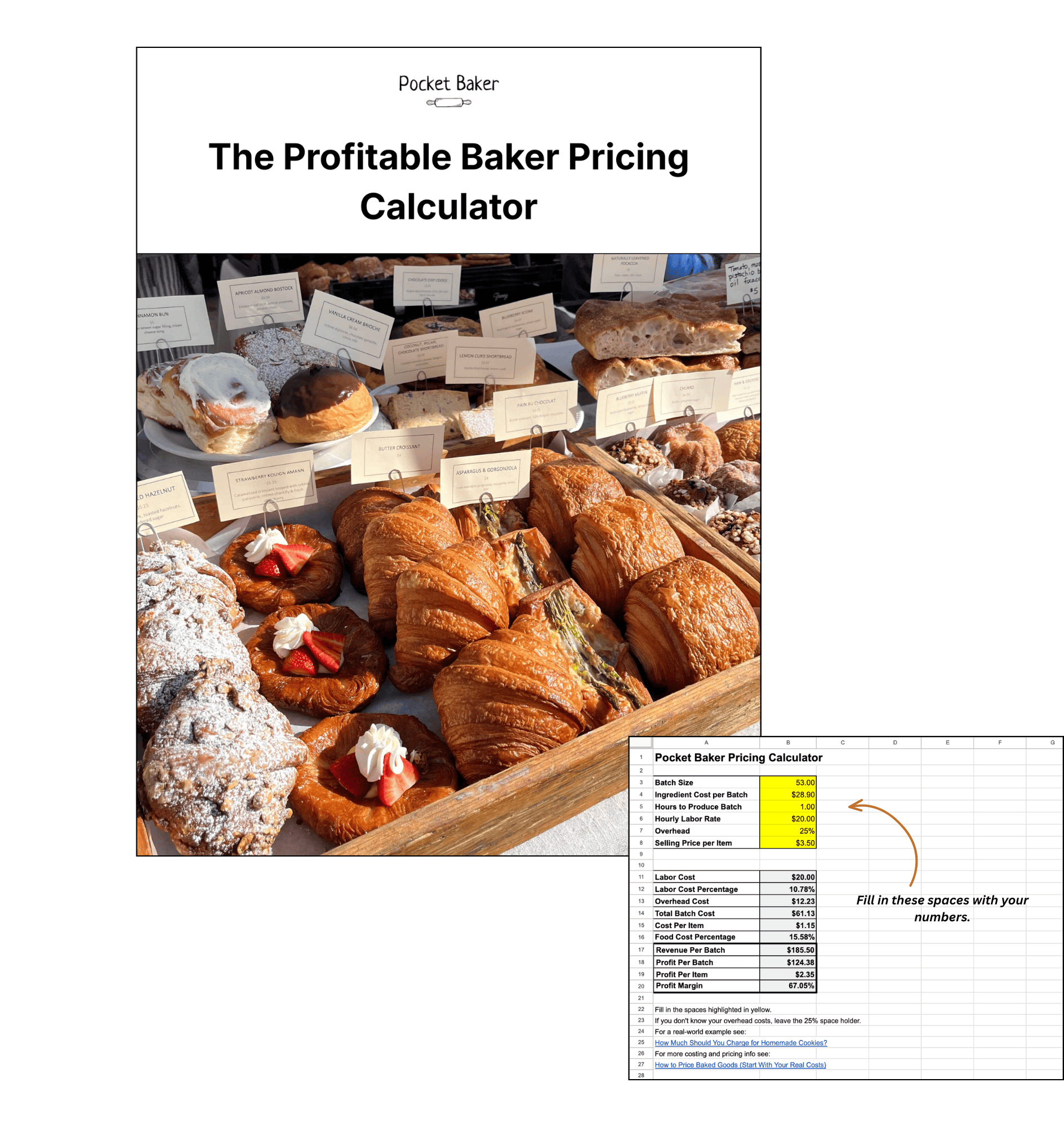
From a sample cookie recipe:
- Ingredients: $28.90
- Labor: $20.00
- Overhead: $12.23
👉Total cost = $61.13
👉 Labor is what ensures your time is accounted for in your pricing.
Pricing System (Start Here)
If you’re unsure where to begin, start with the core pricing guide below.
Step 1: Understand Your Costs
Know exactly what it costs to produce your products.
- 👉 What Is Food Cost in Baking?
- 👉 How to Calculate Labor Cost in Baking
- 👉 What Is Overhead in a Baking Business?
Step 2: Build Your Pricing
Turn your costs into a price that actually works.
- 👉 Core Guide: How to Price Baked Goods (Start With Your Real Costs)
- 👉 Cost vs Value Pricing for Baked Goods
- 👉 Build a Menu That Works (Product Mix)
Step 3: Apply It to Your Products
Use your numbers to price specific items.
- 👉 How Much Should You Charge for Homemade Cookies?
- 👉 How Much Should You Charge for Homemade Cupcakes?
- 👉 How to Price Cakes for Profit
Step 4: Improve Profit Over Time
Refine your pricing as your business grows.
Final Thoughts
Labor is easy to overlook - but your time has value, whether you’re paying yourself right now or not.
When you account for your time consistently:
- your pricing becomes clearer
- your decisions become easier
- your business becomes more sustainable
👉 You’re not just baking - you’re building something that supports your time and effort.
Pocket Baker Perspective
In professional kitchens, labor, food cost, and overhead are all tracked and monitored.
Not to complicate the process - but to understand where the work and cost are going.
👉 That clarity is what makes a business sustainable - and what allows it to grow over time.