






Introduction
A recipe makes 24 cookies, but you need 90.
Doubling a recipe is easy. So is cutting one in half. But what happens when the amount you need doesn’t divide neatly into the original recipe?
Sure, you could multiply a recipe by four and end up with a few extras (never a bad thing if they’re for snacking). But when you’re working with larger batches or custom orders, those extras add up. Controlling how much you produce helps you manage ingredient costs, reduce waste, and - just as importantly - make sure you don’t come up short.
That’s where a conversion factor comes in.
A conversion factor gives you a simple way to calculate exactly how much of a recipe you need, even when the number isn’t a neat double, triple, or half batch.
You only need two numbers:
- how much the original recipe makes
- how much you need to make
From there, you’ll calculate one conversion factor and use that same number to adjust every ingredient in the recipe.
Scaling is also much easier when your recipes are written by weight. If yours are still written in cups and tablespoons, start here:
👉 How to Convert Your Recipes from Cups to Weight (Ounces or Grams)
Jump to:
- Introduction
- Quick Answer: How Do You Scale a Baking Recipe?
- What Is a recipe conversion Factor?
- Step 1 - Find Your Recipe Conversion Factor
- Step 2 - Multiply Each Ingredient by the Conversion Factor
- Why Scaling Recipes by Weight Is Easier
- What About Eggs?
- Using Baker's Percentage to Scale Recipes
- A Simple Recipe Scaling Calculator
- Related Guides
- FAQ
- Final Thoughts
- Pocket Baker Perspective
- Get the FREE Profitable Baker Pricing Calculator
Quick Answer: How Do You Scale a Baking Recipe?
To scale a baking recipe, first calculate your conversion factor:
Desired yield ÷ Original yield = Conversion factor
Then use that number to scale each ingredient:
Original ingredient amount × Conversion factor = New ingredient amount
Example
Your cookie recipe makes 24 cookies, but you need 90.
90 (desired yield) ÷ 24 (original yield) = 3.75
Your conversion factor is 3.75.
Now multiply every ingredient in the original recipe by 3.75 to get the amount needed for 90 cookies.
That's it. Once you know your conversion factor, the rest is simple multiplication.
What Is a recipe conversion Factor?
A conversion factor is the number you multiply each ingredient by to make the amount of product you need.
| Original Recipe | Desired Amount | Conversion Factor |
|---|---|---|
| 24 cookies | 12 cookies | 0.5 |
| 24 cookies | 24 cookies | 1 |
| 24 cookies | 36 cookies | 1.5 |
| 24 cookies | 48 cookies | 2 |
| 24 cookies | 90 cookies | 3.75 |
| 24 cookies | 120 cookies | 5 |
A number below 1 makes the recipe smaller; a number above 1 makes it larger.
Step 1 - Find Your Recipe Conversion Factor
Original recipe:
24 cookies
Desired yield:
90 cookies
Divide the desired yield by the original yield:
90 ÷ 24 = 3.75
Therefore:
Conversion factor = 3.75
Step 2 - Multiply Each Ingredient by the Conversion Factor
Here's a real-life example using a chocolate chip cookie recipe that makes 24 cookies. To make 90 cookies, we'll use the conversion factor we calculated above: 3.75.
| Ingredient | Original Recipe | × 3.75 | Scaled Recipe |
|---|---|---|---|
| Butter | 280 g | × 3.75 | 1,050 g |
| Brown sugar | 280 g | × 3.75 | 1,050 g |
| Granulated sugar | 140 g | × 3.75 | 525 g |
| Eggs | 2 ea | × 3.75 | 7.5 eggs |
| Vanilla extract | 1¾ tsp | × 3.75 | 6.56 tsp |
| AP flour | 480 g | × 3.75 | 1,800 g |
| Baking soda | 1¼ tsp | × 3.75 | 4.69 tsp |
| Baking powder | 1½ tsp | × 3.75 | 5.63 tsp |
| Salt | 1½ tsp | × 3.75 | 5.63 tsp |
| Chocolate | 225 g | × 3.75 | 843.75 g |
Notice how straightforward the weighed ingredients are to scale. Butter goes from 280g to 1,050g, flour from 480g to 1,800g, and chocolate from 225g to 843.75g.
Ingredients measured by count or volume aren't quite as clean. Two eggs become 7.5 eggs, while 1¼ teaspoons of baking soda becomes 4.69 teaspoons.
Rather than trying to measure awkward amounts like these, weigh the amount called for in the original recipe first, then multiply that weight by your conversion factor. This is one reason I prefer to record production recipes entirely by weight - especially recipes I expect to scale regularly.
Every ingredient is multiplied by the same conversion factor, keeping the relationship between the ingredients the same while changing the total yield.
Why Scaling Recipes by Weight Is Easier
Using cups and tablespoons may feel familiar, but they can become awkward when you start scaling a recipe by anything other than a simple half or double batch. Weight gives you precise amounts and much cleaner math.
Compare:
2⅔ cups × 3.75
with:
320g × 3.75 = 1,200g
The second calculation is much easier to work with - and there's no need to figure out what 3.75 times ⅔ of a cup looks like.
Weight also makes it easier to maintain consistent portions, calculate ingredient and portion costs, and accurately price the products you sell.
If your recipes are still written in cups and tablespoons, I recommend converting them to weight before you begin scaling regularly.
👉 Why Using Weight Instead of Volume Is Essential for Accurate Recipe Costing
👉 How to Convert Your Recipes from Cups to Weight (Ounces or Grams)
What About Eggs?
The most accurate way to measure eggs - especially in recipes you scale regularly - is by weight.
There are two reasons for this. First, weighing eggs makes scaling much easier and helps keep your recipe consistent from batch to batch. Second, eggs aren't all exactly the same size. Even within the same size classification, individual eggs can vary in weight. As a recipe is scaled larger, those small differences can add up.
If your scaled recipe calls for a partial egg, simply whisk the eggs together, weigh them, and use the amount you need.
That said, you don't always need to make scaling more precise than the recipe requires. In a large batch, rounding 15.2 eggs down to 15 or 15.7 eggs up to 16 typically represents a very small percentage of the total recipe and may have little noticeable effect.
For recipes where egg quantity is particularly important - or whenever consistency matters most - weight is still the more reliable method.
Using Baker's Percentage to Scale Recipes
Using a recipe conversion factor is one of the simplest ways to resize an established recipe, but it isn't the only method professional bakers use.
For bread and other flour-based formulas, baker's percentage expresses every ingredient as a percentage of the flour weight. This makes it possible to build a recipe around a specific amount of flour - or adjust individual parts of a formula while maintaining control over the rest.
If you simply need 90 cookies instead of 24, a conversion factor is usually the easier tool.
If you want to understand and manipulate the formula itself, baker's percentage becomes much more useful.
👉 Baker's Percentage Explained Simply (No Math Anxiety Required)
A Simple Recipe Scaling Calculator
Recipe Scaling Calculator
Enter the original recipe yield and the amount you need, then add your ingredient amounts below. The calculator will find your conversion factor and calculate the new amount of each ingredient automatically.
| Ingredient | Original Amount | Unit | Scaled Amount | |
|---|---|---|---|---|
| — |
For the most accurate results, enter ingredient amounts by weight whenever possible.
Related Guides
Measure & Understand Your Recipes
👉 How to Convert Your Recipes from Cups to Weight (Ounces or Grams)
Convert an established recipe to weight so it can be scaled accurately and consistently.
👉 Baker's Percentage Explained Simply (No Math Anxiety Required)
Learn how professional bakers express recipes as formulas so they can be scaled, compared and intentionally adjusted.
FAQ
How do you calculate a recipe conversion factor?
Divide the desired yield by the original yield. For example, if a recipe makes 24 cookies and you need 60, 60 ÷ 24 = 2.5. Multiply every ingredient by 2.5.
How do I scale a recipe from 12 servings to 20?
20 ÷ 12 = 1.67. Your conversion factor is approximately 1.67.
Can you use a conversion factor to make a recipe smaller?
Yes. The same formula works in reverse. If a recipe makes 24 portions and you want 12, 12 ÷ 24 = 0.5.
How do you scale eggs in a recipe?
For the most accurate results, weigh your eggs and multiply that weight by your conversion factor. If your scaled recipe calls for a partial egg, whisk the eggs together and weigh the amount you need.
For larger batches, rounding to the nearest whole egg will often have little noticeable effect. However, recording eggs by weight is the best way to keep recipes consistent - especially if you scale them regularly.
Is baker's percentage the same as a conversion factor?
No. A conversion factor changes the quantity of an existing recipe proportionally. Baker's percentage expresses each ingredient in relation to flour weight and can be used to scale or adjust a formula.
Final Thoughts
Being able to scale recipes is another tool that helps make the overall production system work.
Rather than guessing or simply making more than you need, scaling allows you to produce the right amount with confidence. That means less waste, better control over ingredient costs, and less chance of having to make additional product because you came up short.
Once you know how much your original recipe makes and how much you need, a conversion factor does the rest:
Desired yield ÷ original yield = conversion factor
For recipes you scale regularly, working by weight makes the process even easier. Instead of dealing with fractions of cups, teaspoons, or eggs, every ingredient can be adjusted using the same calculation.
It's a reliable system you can use whether you're making 12 cookies, 90 cookies, or several hundred.
Pocket Baker Perspective
In professional baking, recipes rarely stay at one fixed size.
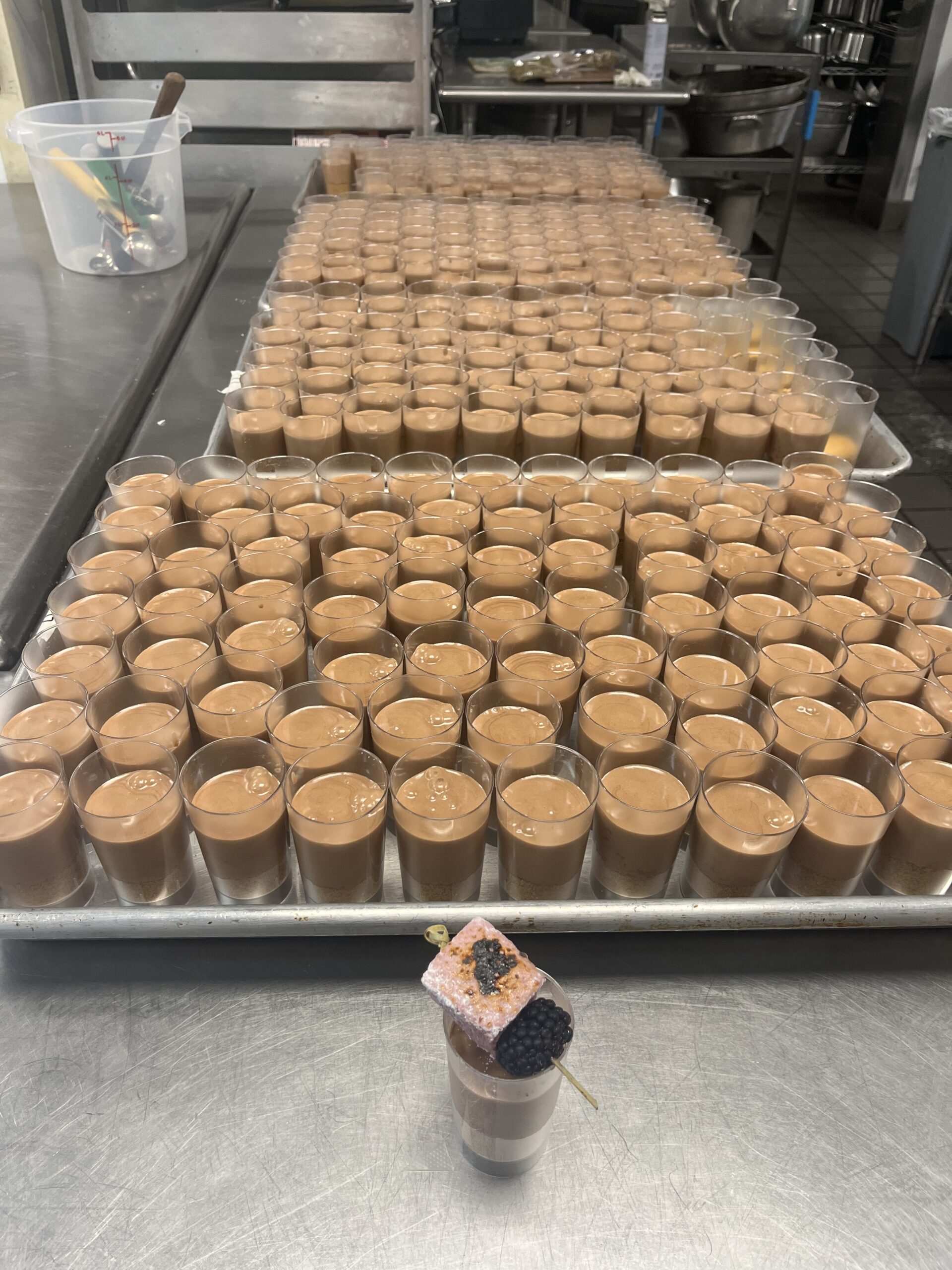
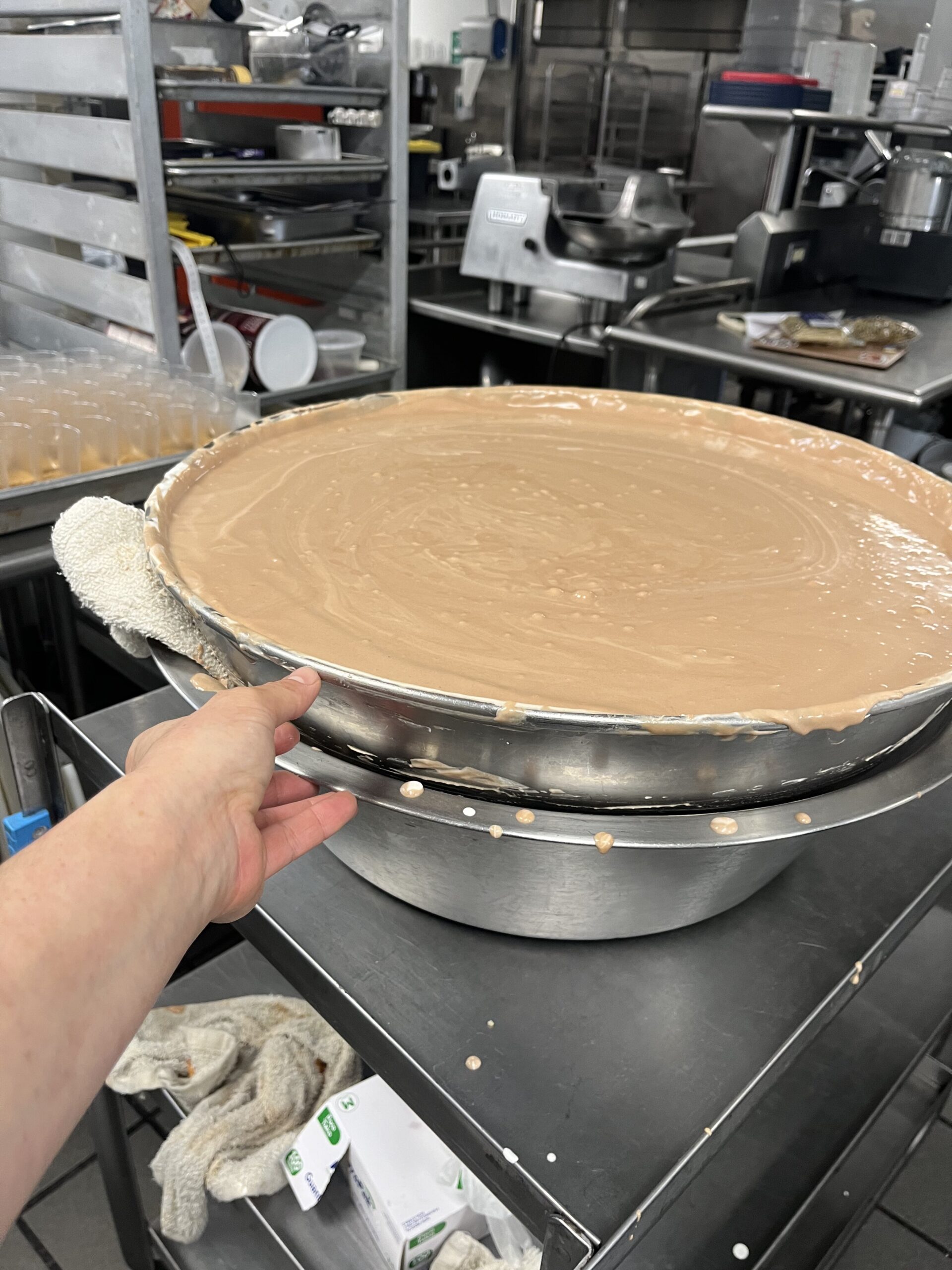
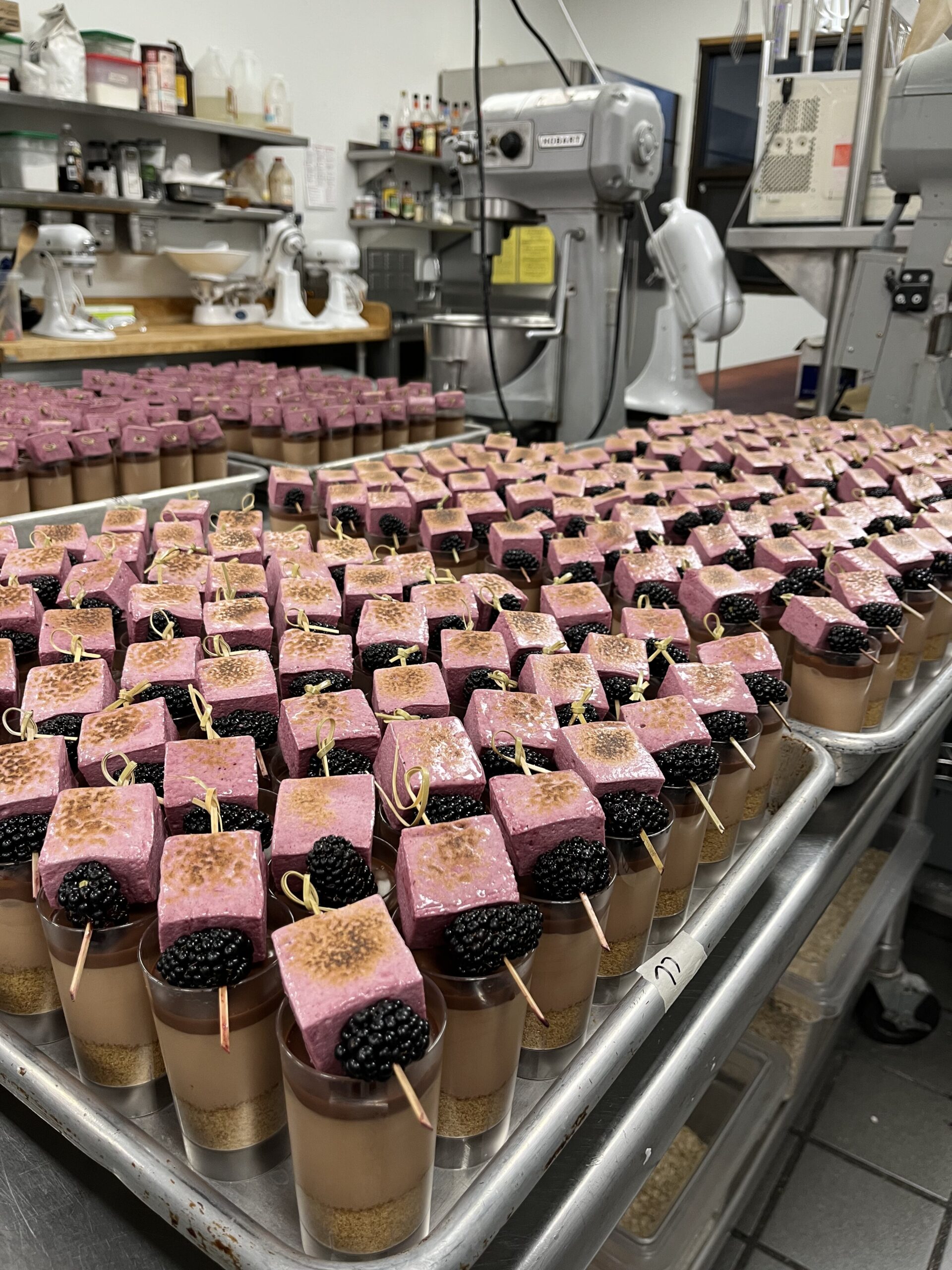
When I needed to make more than 300 s'mores mousse desserts, I couldn't simply make a few batches of chocolate mousse and hope I had enough. The mousse was only one part of the day's production, and there wasn't time to discover halfway through that I needed another batch - or to make far too much and waste ingredients and labor.
Instead, I determined how much mousse I needed for each glass and used that to calculate the total amount required. I divided that by the yield of my original recipe to find my conversion factor, then used that number to calculate how much of each ingredient I needed.
That's the practical value of recipe scaling.
One day you may need two dozen of something; another order may require several hundred. If you know the yield of your original recipe and keep your ingredients recorded by weight, you don't need a separate recipe for every quantity. You can scale the recipe to match the production you have in front of you.
A few extra cookies at home probably don't matter. But at larger volumes, consistently overproducing means extra ingredients, labor, and cost. Coming up short can be even more disruptive.
Scaling gives you control over production instead of making production fit the recipe.