




Why Baker’s Percentage Is Useful
Most bread recipes work just fine - until you want to change something.
Maybe you want to:
- make a little more or little less dough
- slow down or speed up fermentation
- increase or decrease hydration
Baker’s percentage is a simple system that turns recipes into ratios instead of fixed amounts, so you can make adjustments without guessing or breaking the recipe.
Jump to:
- Why Baker’s Percentage Is Useful
- 1. What Is Baker’s Percentage?
- 2. Why Bakers Use Baker’s Percentage
- 3. What Recipes Can Use Baker’s Percentage?
- 4. What You Need Before You Start
- 5. How to Convert a Recipe to Baker’s Percentage
- 6. How to Adjust a Recipe Using Baker’s Percentage
- 7. Common Mistakes to Avoid
- Related Guides
- Final Thoughts
- Get the FREE Profitable Baker Pricing Calculator
1. What Is Baker’s Percentage?
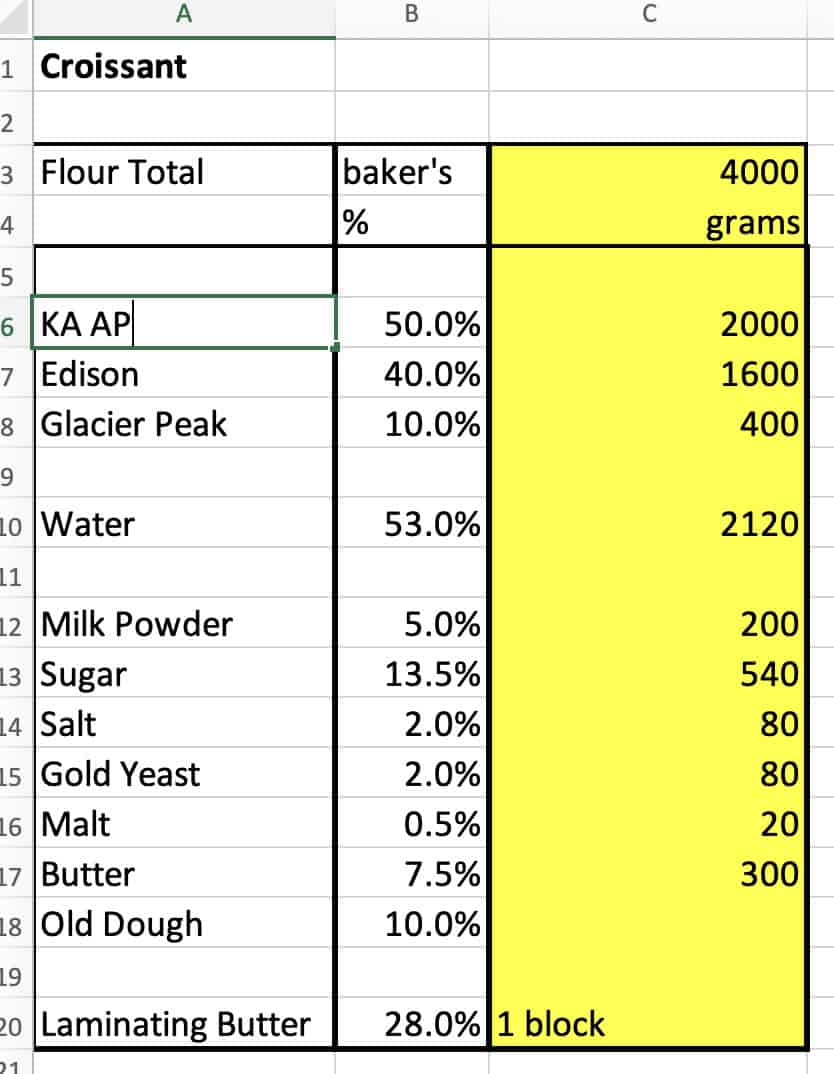
Baker’s percentage means:
Every ingredient in a recipe is expressed as a percentage of the total flour weight.
There is one rule that never changes:
Flour = 100%
Everything else - water, salt, yeast, sugar, fat - is calculated in relation to the flour.
That’s it.
This system doesn’t replace recipes - it explains them.
2. Why Bakers Use Baker’s Percentage
Baker’s percentage helps you:
- adjust recipes with intention
- compare formulas easily
- scale recipes with consistency
More importantly, it helps you understand what a recipe is doing.
You begin to see the relationships between ingredients, which makes it easier to develop, adjust, and repeat formulas.
3. What Recipes Can Use Baker’s Percentage?
Baker’s percentage works especially well for bread, including:
- lean doughs (artisan bread, pizza dough, baguettes)
- enriched doughs (brioche, sweet rolls, sandwich bread)
- laminated doughs (croissants, danish, puff pastry)
- sourdough (naturally leavened breads and rolls)
Baker’s percentage is most useful when flour is the primary ingredient in a recipe. While it’s less commonly used this way, the same system can also be applied to cookies, cakes, quick breads and other pastries once a formula is established.
4. What You Need Before You Start
You only need:
- a digital scale
- all ingredients weighed in the same unit (grams are best)
- the full ingredient list
⚠️ Baker’s percentage only works with weight, not volume.
If your recipe is written in cups, weigh the ingredients as you make it.
👉 How to Convert Your Recipes from Cups to Weight
5. How to Convert a Recipe to Baker’s Percentage
Step 1: Add up all the flour
Example recipe:
- Flour: 1,000 g
That number becomes 100%.
Step 2: Divide each ingredient by the flour weight
Example ingredients:
- Flour: 1,000 g
- Water: 650 g
- Salt: 20 g
- Yeast: 20 g
Now calculate each percentage:
- Flour: 1000 ÷ 1000 = 100%
- Water: 650 ÷ 1000 = 65%
- Salt: 20 ÷ 1000 = 2%
- Yeast: 20 ÷ 1000 = 2%
Once a recipe is written this way, it becomes flexible instead of fixed.
Try It: Convert a Real Recipe to Baker’s Percentage
The easiest way to understand baker’s percentage is to see it applied to an actual formula.
The calculator below is preloaded with a focaccia dough using two flours. Together, the flours equal 100%. You can change any ingredient weight to see how its baker’s percentage changes automatically.
Once you're comfortable with that, select Adjust the Formula. Instead of changing the ingredient weight, change the percentage and the calculator will determine the new weight for you.
Baker's Percentage Calculator
Baker's percentage expresses every ingredient as a percentage of the total flour weight. In this focaccia formula, the two flours together equal 100%.
Change an ingredient weight to see its baker's percentage calculate automatically.
| Ingredient | Baker's % | Weight (g) | Flour |
|---|---|---|---|
| Total Formula | 195.33% | 2,344 g |
How baker's percentage works: Add all of the flour in the formula together. That total is always 100%. Every other ingredient is then calculated as a percentage of that flour weight.
6. How to Adjust a Recipe Using Baker’s Percentage
This is where baker’s percentage becomes useful in real life.
Example 1: Increasing the Amount of Flour
Let’s say you want to make a larger batch using 1,200 g of flour.
You keep the same percentages and recalculate the weights:
- Water:
1,200g x 65% = 780 g - Salt:
1,200g x 2% = 24 g - Yeast:
1,200g x 2% = 24 g
The dough stays balanced because the ratios stay the same.
Example 2: Decreasing the Amount of Yeast
Let’s say fermentation is moving too fast and you want to slow it down.
Original yeast percentage:
- 2%
New yeast percentage:
- 1.5%
With 1,000 g flour:
- Yeast:
1.5% × 1,000 g = 15 g
Everything else stays the same:
- Water: 650 g
- Salt: 20 g
You’ve adjusted fermentation without guessing.
Example 3: Increasing Hydration
Let’s say your dough feels too stiff and you want it more extensible.
Original hydration:
- 65%
New hydration:
- 70%
With 1,000 g flour:
- Water:
70% × 1,000 g = 700 g
Salt and yeast remain unchanged.
This lets you intentionally adjust dough texture instead of randomly adding water mid-mix.
7. Common Mistakes to Avoid
- Changing ingredient weights without adjusting ratios
- Mixing volume and weight measurements
- Forgetting that flour is always the reference point
Baker’s percentage only works when the relationships stay intact.
Related Guides
Measure & Understand Your Recipes
👉 How to Convert Your Recipes from Cups to Weight (Ounces or Grams)
Convert an established recipe to weight so it can be scaled accurately and consistently.
👉 How to Scale a Baking Recipe (Using a conversion Factor)
A simple way to calculate exactly how much of a recipe you need, even when the number isn’t a neat double, triple, or half batch.
Final Thoughts
Baker’s percentage isn’t about being overly technical. It’s about understanding the relationships between ingredients so you can make intentional choices when adjusting a recipe.
When you understand how ingredients relate to flour, you can:
- troubleshoot with confidence
- make changes without guessing
- bake consistently instead of reactively
And that’s how good baking becomes reliable baking.