




Ratios: Why Look at Cookies This Way?
Chocolate chip cookies are deceptively simple.
Flour. Sugar. Butter. Eggs. Chocolate.
Most recipes look nearly identical at a glance.
So why do some cookies spread wide and bake crisp,
while others stay thick and soft?
Why do some remain chewy for days, and others set firm within hours?
It isn’t magic.
And it isn’t secret ingredients.
It’s ratio.
Baker’s percentage gives us a way to see what’s happening inside a recipe instead of guessing. By setting flour at 100% and expressing every other ingredient relative to it, patterns emerge quickly - patterns that explain why cookies behave the way they do.
This post compares several well-known chocolate chip cookie recipes using baker’s percentage. Not to rank them - but to understand them.
Jump to:
- Ratios: Why Look at Cookies This Way?
- A Quick Reminder: What Baker’s Percentage Shows
- Ingredient Balance at a Glance
- Grouped by Outcome
- What Changes When Ratios Change?
- Why These Ingredients Matter
- A Note on Leavening (Important Context)
- Cookie Formula Benchmarks
- Final Thoughts: A Pocket of Wisdom
- Get the FREE Profitable Baker Pricing Calculator
A Quick Reminder: What Baker’s Percentage Shows
- Flour is always 100%.
- Every other ingredient is calculated as a percentage of the flour weight.
- The numbers reveal relationships - not rules.
Baker’s percentage helps you understand what a formula is built to do.
👉 Baker’s Percentage Explained Simply (No Math Anxiety Required)
Ingredient Balance at a Glance
Chocolate Chip Cookies - Baker’s Percentage Comparison
(Flour = 100%)
Below is a reference comparison of several widely published chocolate chip cookie recipes rewritten in baker’s percentage.
These are not “best” or “worst.” They’re familiar examples that illustrate intentional design.
- Percentages are calculated from published gram-based ingredient lists.
- Eggs are estimated at ~50 g per large egg where listed as “each.”
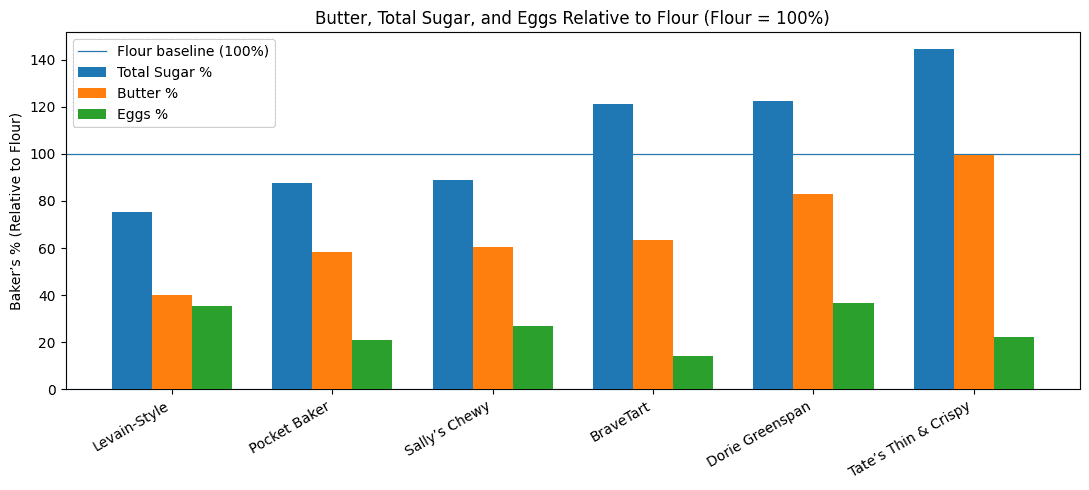
Before examining individual formulas, step back and look at balance.
The key drivers of cookie behavior are total sugar, butter, and eggs. When viewed side by side, their proportions tell a clear story.
Grouped by Outcome
Thick & Structured
Minimal spread · substantial height
| Recipe | Total Sugar % | Butter % | Eggs % | Expected Outcome |
|---|---|---|---|---|
| Serious Eats (Levain-Style Thick) | 75.2 | 39.9 | 35.3 | Very thick, minimal spread |
- Lower total sugar
- Moderate fat
- Higher egg percentage
- Often higher chocolate percentage
These formulas set structure early and resist spread.
Chewy & Balanced
Controlled spread · chewy center
| Recipe | Total Sugar % | Butter % | Eggs % | Expected Outcome |
|---|---|---|---|---|
| Pocket Baker Classic CCC | 87.5 | 58.3 | 20.8 | Controlled spread, chewy center |
| Sally’s Baking Addiction (Chewy) | 89.0 | 60.5 | 26.7 | Soft, chewy, moderate spread |
- Moderate total sugar
- Moderate butter
- Moderate egg percentage
These formulas balance tenderness and structure, allowing controlled spread with a soft interior.
Classic Spread & Rich
Noticeable spread · crisp edges · soft center
| Recipe | Total Sugar % | Butter % | Eggs % | Expected Outcome |
|---|---|---|---|---|
| Serious Eats (BraveTart) | 121.1 | 63.4 | 14.1 | Spread, crisp edges, chewy middle |
| Dorie Greenspan (Classic CCC) | 122.4 | 83.1 | 36.8 | Rich, spread, soft interior |
- Higher total sugar
- Higher butter
These cookies spread more before setting, creating crisp edges and chewy centers.
Thin & Crispy
Wide spread · crisp throughout
| Recipe | Total Sugar % | Butter % | Eggs % | Expected Outcome |
|---|---|---|---|---|
| Serious Eats (Tate’s-Style Thin & Crispy) | 144.4 | 100.0 | 22.2 | Thin, wide, crisp |
- Very high sugar
- Very high butter
Fat and sugar melt quickly, and the dough offers little structural resistance before setting.
What Changes When Ratios Change?
Instead of thinking in terms of “cookie problems,” think in terms of outcomes.
When ratios shift, behavior shifts.
Lower sugar + higher eggs + lower butter
→ thicker, more structured cookies
Moderate sugar (especially with higher brown sugar) + moderate eggs + moderate butter
→ chewy centers and controlled spread
High sugar + moderate eggs + moderate butter
→ classic spread with crisp edges
Extreme sugar + high fat + lower egg
→ thin, wide, crisp cookies
Why These Ingredients Matter
Sugar
- Drives spread
- Increases browning and caramelization
- Impacts crispness vs chew
Butter (Fat)
- Adds richness and tenderness
- Encourages spread
- Contributes to edge crispness
Eggs
- Provide structure and lift
- Add moisture
- Higher percentages resist spread and support thickness
Chocolate Percentage (not shown)
High add-in ratios can physically support thickness by interrupting spread and reinforcing structure.
A Note on Leavening (Important Context)
You may notice leaveners aren’t included in these comparisons.
That’s intentional.
Baking soda and baking powder absolutely influence spread, browning, and structure - but for clarity, this post isolates flour, sugar, butter, and eggs to better understand their primary roles.
We’ll revisit leavening in a separate post.
Cookie Formula Benchmarks
| Intended Outcome | Total Sugar % | Butter % | Eggs % | What This Signals |
|---|---|---|---|---|
| Thick & Structured | 70–80% | 35–45% | 30–40% | Early structure, minimal spread |
| Chewy & Balanced | 85–95% | 50–60% | 20–30% | Controlled spread, soft center |
| Classic Spread | 115–125% | 60–85% | 15–25% | Noticeable spread, crisp edges |
| Thin & Crispy | 140%+ | 90–110% | 10–20% | Rapid melt, wide spread |
These are patterns - not strict rules - but they offer a powerful framework for reading any chocolate chip cookie recipe.
👉 Cookies troubleshooting: Common Cookie Problems
Final Thoughts: A Pocket of Wisdom
Most cookie “problems” aren’t mistakes.
They’re signals.
Signals that ratios, technique, and expectations aren’t fully aligned yet.
Baker’s percentage gives you a language to read those signals with confidence.
And when you remove guesswork from baking, it becomes more repeatable, more efficient, and far less stressful.
That’s where professional ease begins.