

Every week, someone asks for “the best cinnamon roll recipe.”
Dozens of comments follow.
Links are shared.
Debates begin.
The assumptions are often the same:
The recipe must be the problem.
But when you look closely, most cinnamon roll dough recipes are remarkably similar. The variation usually falls within a small, workable range of hydration and enrichment.
So if the ingredients aren’t wildly different… what is?
I compared several popular cinnamon roll dough formulas using baker’s percentage to see what’s really happening.
At first glance, these recipes can look very different - some slightly richer, others a little leaner, and one brioche that's highly enriched. But when viewed through baker’s percentage, the similarities become clear.
Most formulas fall within a relatively narrow range of hydration and enrichment. Even when a dough shifts toward higher butter and egg percentages, the structure remains workable.
In other words:
The ratios move - but they don’t break the system.
The real difference in outcome often comes down to method: proper mixing, fermentation, and dough temperature.
When those fundamentals are executed well, a wide range of enriched dough formulas can produce excellent results.
If your cinnamon rolls aren’t turning out the way you expect, the issue is usually in the process - not the formula.
👉 Why Your Cinnamon Rolls Turn Out Dense, Dry, or Flat (and How to Fix Them)
Jump to:
- Cinnamon Roll Doughs Live in the Same Neighborhood
- If the Ratios Are Similar, Why Do Results Vary So Much?
- Mixing: Structure Before Fermentation
- Fermentation and Proofing: Time, Temperature, and Observation
- Why Brioche Still Works
- Bread Making: Start Here
- Final Thoughts
- Pocket Baker Perspective
- Get the FREE Profitable Baker Pricing Calculator
Cinnamon Roll Doughs Live in the Same Neighborhood
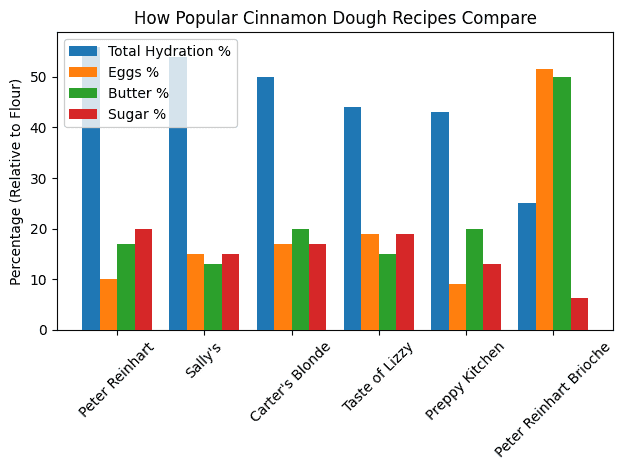
When you compare popular recipes side by side, you’ll notice:
- Hydration falls within a consistent range
- Sugar stays within a predictable band
- Butter and eggs vary - but not dramatically
- Even brioche-level enrichment remains structurally viable
These formulas are not opposites.
They are variations within a functional band.
And they are built on the same structural foundation.
Even a dough that pushes toward brioche-level enrichment can produce beautiful cinnamon rolls. At that point, it becomes a matter of preference - not correctness.
👉 Baker’s Percentage Explained Simply (No Math Anxiety Required)
If the Ratios Are Similar, Why Do Results Vary So Much?
Because formula is only half the equation.
Other variables include:
- Mixing development
- Dough temperature
- Fermentation time
- Fermentation temperature
- Proofing by visual and tactile cues - not just the clock
This is where most cinnamon roll problems actually originate.
Mixing: Structure Before Fermentation
Gluten development builds the framework that traps gas.
Gas is what creates softness, lift, and internal structure.
When dough is underdeveloped, it cannot support expansion. It may spread outward instead of rising upward, crack and often bakes into dry, dense rolls - the same structural issue that causes many loaves of bread to turn out heavy as well (something I explain in more detail in 👉 Why Is My Bread Dense? 6 Common Causes and How to Fix Them).
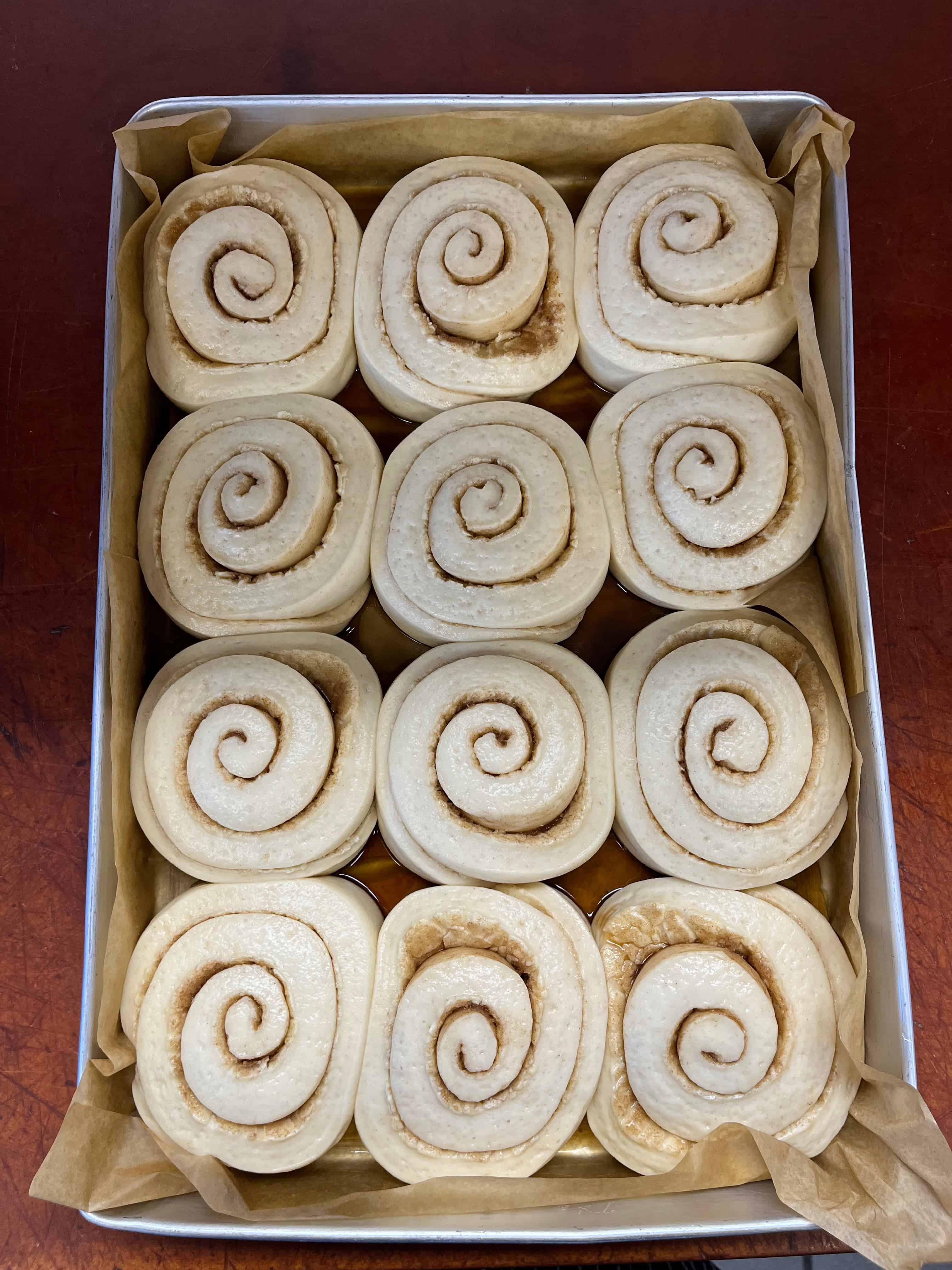
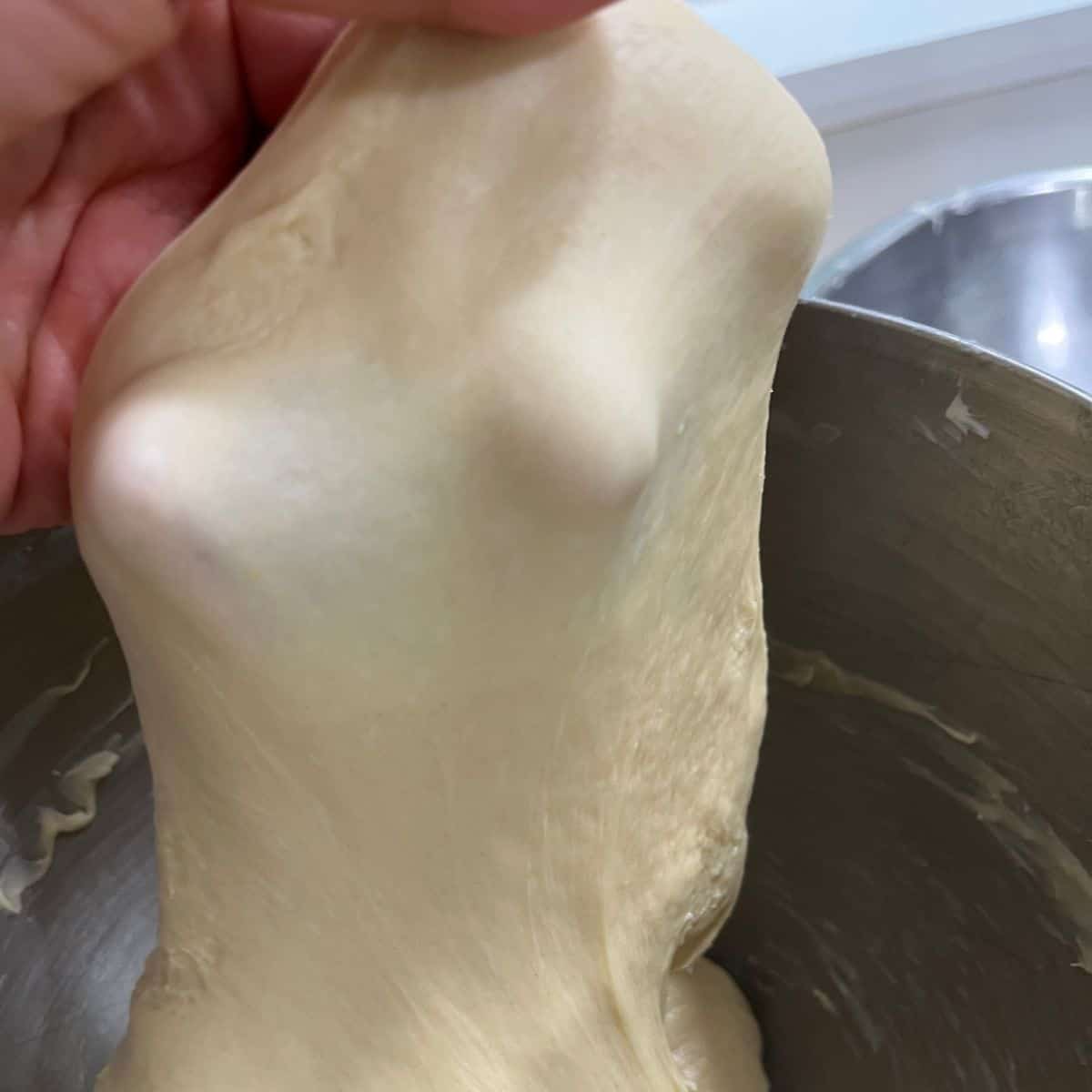
Properly mixed cinnamon roll dough should be smooth, supple, and slightly shiny. It should pass the windowpane test - stretching thin without tearing. Reaching this stage is critical for achieving pillowy rolls that remain soft even a day or two later.
Overmixing your cinnamon roll dough is highly unlikely by hand and even difficult to achieve in most home stand mixers. If the dough begins breaking down before it passes the windowpane test, excessive heat is often the cause. Dough that becomes too warm during mixing can weaken before structure is fully developed.
In practice, most home bakers do not overmix enriched dough. Underdevelopment is far more common.
If dough feels excessively tough or dry, the issue is often added flour during kneading. As flour hydrates and gluten bonds form, the dough naturally becomes less sticky. Adding more flour interferes with hydration and alters the balance of the formula.
The central principle is simple:
Structure must be established before fermentation can do its work.
If the dough cannot retain gas, fermentation won’t fix it - it will simply reveal the weakness.
If you’d like a detailed breakdown of how to develop dough properly, I’ve covered it step-by-step in 👉 A Guide to Bread Making: 12 Steps for the Home Baker.
Fermentation and Proofing: Time, Temperature, and Observation
Yeast activity is temperature dependent.
Warm kitchens accelerate fermentation.
Cold dough slows it dramatically.
For enriched dough like cinnamon rolls, the ideal dough temperature coming out of the mixer is around 78–82°F. In a warm environment, bulk fermentation typically takes about 1½ to 2 hours.
If you begin with warm milk, your kitchen is already warm, and the dough comes off the mixer at 95–100°F or higher, fermentation can move too quickly. The dough may overferment before it has built sufficient strength, and both structure and flavor will suffer.
Signs of overfermentation during bulk rise include:
- A dry or dull surface
- Loss of sheen
- Weak or slack structure
- A noticeable alcoholic smell
Watch the Dough, Not the Clock
Time guidelines are estimates. Visual and tactile cues matter more.
During fermentation (first rise and final proof), look for:
- Noticeable increase in volume
- Dough that feels lighter and aerated
- A surface that still has some shine
Or try the poke test:
Lightly flour your finger and press gently into the dough about ½ inch deep.
- Underproofed: springs back quickly
- Properly proofed: holds the indentation slightly but remains elastic
- Overproofed: does not spring back and may deflate
Well-proofed cinnamon rolls should feel inflated - almost like a soft balloon - while still holding structure.
Why Brioche Still Works
When you look at the comparison graph, you’ll notice that even formulas approaching brioche-level richness remain structurally viable.
Significantly higher butter.
Significantly higher egg.
Lower hydration (milk).
Yet the system still works.
If method is sound:
- Gluten is properly developed
- Dough Temperature and fermentation is controlled
The dough performs.
The formula can flex. The fundamentals cannot.
Bread Making: Start Here
If you're trying to become a more confident bread baker, it's helpful to understand how each stage of the process builds on the next.
Step 1: Understand the Bread-Making Process
Start by learning how bread comes together from beginning to end.
👉 Bread Making Explained: The 12 Steps That Matter
Step 2: Build Strong Dough
A well-developed dough is the foundation of good bread.
👉 Why Is My Dough Sticky? (And How to Fix It)
👉 Why Is My Dough Not Smooth or Elastic? (And How to Fix It)
👉 How to Knead Dough Properly (And How to Know When It's Ready)
Step 3: Master Fermentation & Proofing
Learn how yeast, time, and temperature affect your dough.
👉 Do You Really Need to Proof Yeast? (Instant vs Active Dry Explained)
👉 How to Proof Bread in the Oven (Without Overproofing It)
👉 How Long Should Bread Proof? (And How to Know When It's Ready)
Step 4: Troubleshoot Your Bread
If something doesn't turn out as expected, these guides can help.
👉 Why Is My Bread Dense? (6 Common Causes and How to Fix Them)
👉 Can You Overknead Dough? (Why It's Less Common Than You Think)
Step 5: Apply It to Specific Bakes
See how these same principles apply to enriched doughs and specialty breads.
👉 Troubleshooting Cinnamon Rolls (Fix Dense, Dry or Flat Rolls)
👉 Are All Cinnamon Roll Recipes Basically the Same? (Here's What Actually Matters)
Final Thoughts
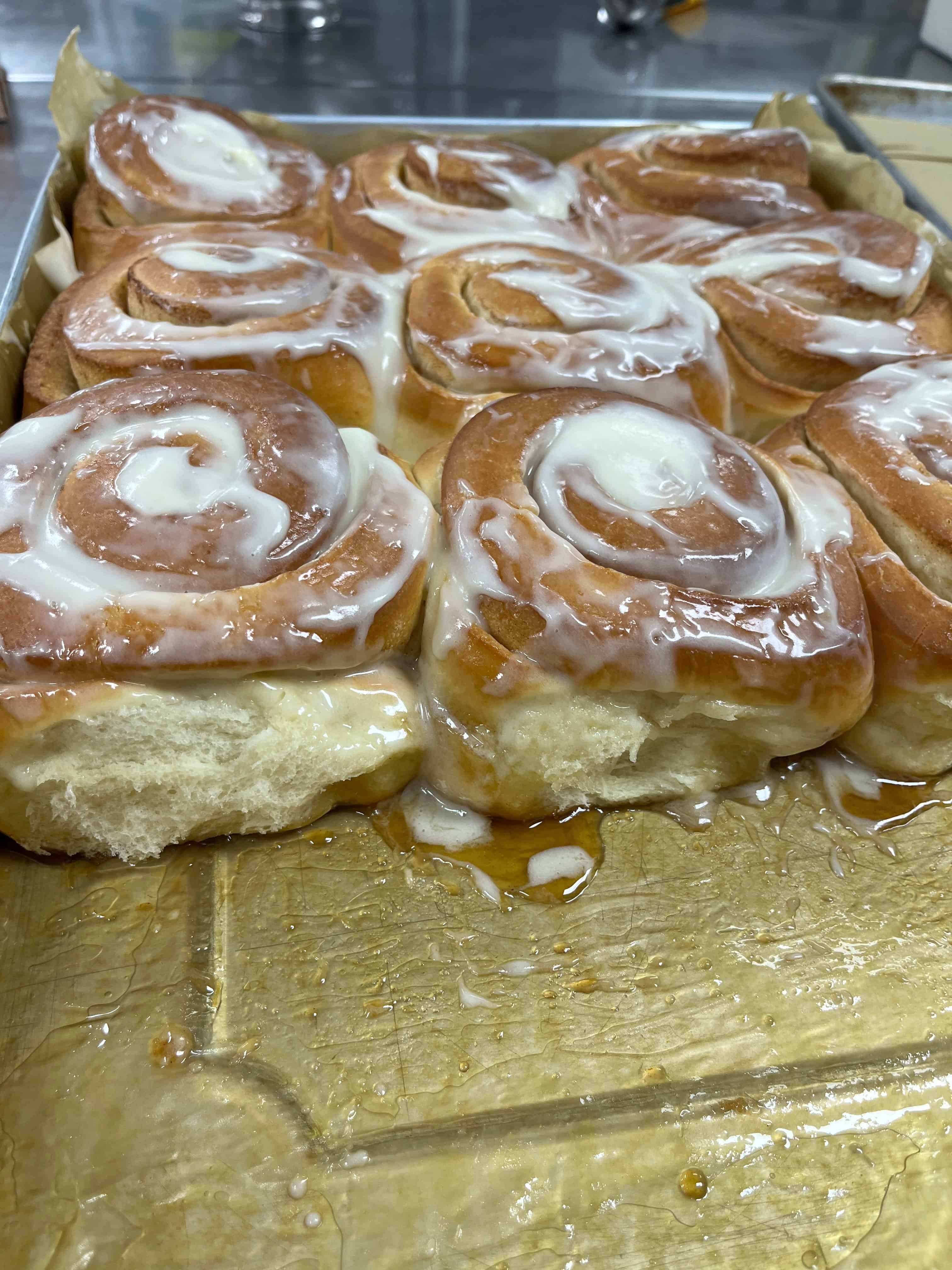
Cinnamon roll formulas are more alike than they are different.
The difference between average and exceptional almost always comes down to method.
Understanding mixing, fermentation, and dough temperature will improve your baking far more than chasing a new recipe ever will.
The ratios move - but they don’t break the system.
And once you understand the system, you stop searching for a better recipe - and start baking better rolls.
Pocket Baker Perspective
In a professional kitchen, when something goes wrong, the first step isn’t to change the recipe.
We check measurement accuracy.
We review the process - mixing time, dough temperature, fermentation time and temperature, and handling techniques.
If dough feels weak, we may evaluate development.
If it rises too quickly, we may adjust temperature.
If the final product lacks volume we may reassess fermentation.
That’s not to say ingredients never need adjusting.
But the formula is rarely the first thing that needs to change - especially in a home kitchen.
Adding cream before baking, adjusting filling ratios, brushing with butter - these are preferences. They influence tenderness, richness, and flavor.
Refrigerating and freezing are workflow strategies that can work with almost any dough - as long as the method remains sound.
But none of these alter the structural foundation of the dough.
Cream may make poorly mixed rolls feel moist and soft when they first come out of the oven. But once they cool, structural weaknesses reveal themselves.
Process determines structure.
Structure determines outcome.